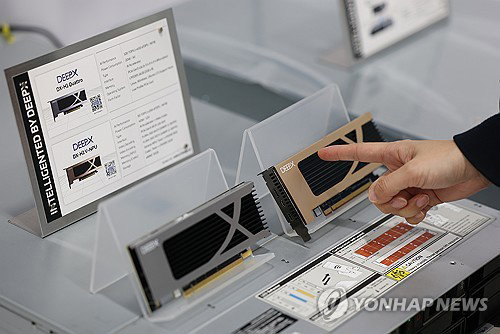
As the core focus of the artificial intelligence (AI) market shifts from 'training' to 'inference,' domestically-produced neural processing units (NPUs) are rapidly emerging as the key driver that will determine the Republic of Korea's AI sovereignty and industrial competitiveness. The government is undertaking large-scale NPU transition projects in the public sector, while domestic companies are successfully applying domestic NPUs combined with large language models (LLMs) to real-life services, opening a new era of AI supply chain independence.
As of today (July 19, 2026), the center of gravity in the AI market has shifted beyond model training to 'inference' for actual service implementation. NPUs are specialized in this AI inference task and have the advantage of lower power consumption and higher cost efficiency compared to graphics processing units (GPUs). This presents a new alternative to the existing AI hardware ecosystem centered on Nvidia GPUs.
The government recognizes domestic NPUs as core hardware for securing AI sovereignty and is accelerating their deployment in public sectors. In particular, the government is pursuing a project to convert approximately 50,000 public CCTV cameras to an NPU-based AI monitoring system over the next five years starting this year, and is also implementing a naval CCTV replacement project in the defense sector. Kim Eun-ju, head of the Korea Intelligence Information Society Promotion Agency (NIA), emphasized on July 14 that "domestic NPUs are the core foundation of AI sovereignty for developing and operating AI infrastructure with our own technology," and that leading adoption in the public sector will serve as a priming pump for the early market.
In the private sector, successful cases of combining domestic NPUs and LLMs are increasing the possibility of AI independence. On July 15, domestic AI company Upstage (LLM 'Solar'), NPU developer FuriosaAI (NPU 'Renegade'), and portal 'Daum' operator AXZ announced their collaboration results. Running the 'Solar' LLM on the 'Renegade' NPU and applying it to Daum's real-time search summary service resulted in processing approximately 500 million tokens per day while achieving performance similar to Nvidia GPUs. This proves that token processing costs can be significantly reduced and demonstrates the economic viability and efficiency of domestic AI infrastructure.