As the importance of the composition of dollar and gold assets over the 'total amount' of foreign reserves becomes apparent for defending exchange rates against U.S. interest rate hike shocks, the Bank of Korea, which ranks at the bottom of the world in gold holdings, is drawing attention as it reviews expanding its gold share through purchases of gold exchange-traded funds (ETFs).
When the U.S. Federal Reserve (Fed) raises interest rates, each country's currency value is analyzed to depreciate by approximately 0.4% on average. This was revealed in an overseas academic paper authored by four professors including Joshua Aizenman, introduced by the Bank of Korea's Economic Research Institute on the 22nd. The paper analyzed 18 developed and emerging countries from 2009 to 2023 (Australia, Brazil, Canada, Chile, etc.), and Korea was not included in the analysis subjects.
According to the results of this study, when a central bank's U.S. dollar-denominated foreign reserves as a share of gross domestic product (GDP) are 20.4 percentage points (p) higher than average, the depreciation of currency value shrinks by up to 0.1%p. Gold holdings also showed that when the share relative to GDP is 1.9%p higher than average, the depreciation of currency value shrinks by approximately 0.04%p. While the effect is smaller compared to dollar assets, it plays a complementary role in mitigating exchange rate shocks. In contrast, non-dollar assets did not show statistically significant exchange rate shock mitigation effects, further highlighting the importance of dollar and gold assets.
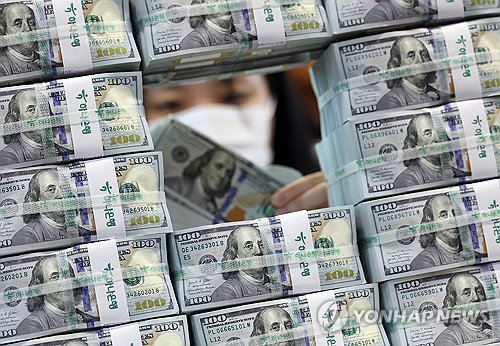
These research findings deepen concerns for the Bank of Korea in managing foreign reserves. The Bank of Korea's gold holdings stood at 104.4 tons as of the end of last year (end of 2025), ranking 39th among world central banks. Gold accounts for 3.2% of total foreign reserves, placing it in the "world's lowest tier" alongside Hong Kong (0.1%) and Colombia (1.0%). The Bank of Korea has not made additional gold purchases since 2013. However, the share of U.S. dollars in the Bank of Korea's foreign reserves stood at 69.5% as of the end of last year, exceeding the global average of 56.8%, maintaining relatively strong advantages in terms of dollar assets.