Humanity has taken another step forward in understanding the universe. A candidate for the first extrasolar moon discovered outside the solar system is shaking up the existing cosmic classification system and raising new scientific questions.
An international research team announced the discovery of the first candidate exomoon outside the solar system in the CD-35 2722 system, located 87 light-years from Earth. Notably, in this system, a brown dwarf (CD-35 2722 B) with a mass 37 times that of Jupiter orbits a central star with 40% of the Sun's mass in a 5,000-year cycle, and the newly discovered celestial body has been confirmed as a satellite orbiting the brown dwarf in a 171-day cycle with a minimum mass of 0.9 times Jupiter's mass. With an unprecedented configuration of "star-brown dwarf-satellite" rather than the conventional "star-planet-moon" classification system, this is being evaluated as opening a groundbreaking new horizon for the cosmic scientific community.
The research team, led by Dr. Kevin Hoeij of Chile's Diego Portales University and the European Southern Observatory (ESO), conducted observations intensively over approximately 2 years and 4 months from October 2023 to February 2026. Using ESO's Very Large Telescope (VLT) and the Cryogenic High-Resolution Infrared Echelle Spectrometer (CRIRES ), the team conducted 23 precision observations of the CD-35 2722 system, a 10-million-year-old stellar system located in Puppis. The research team applied the radial velocity technique to the brown dwarf CD-35 2722 B and detected the phenomenon of the brown dwarf oscillating with a 171-day period. The research results showing that this phenomenon is best explained by the existence of an exomoon with a minimum mass of 0.9 times Jupiter's mass are increasing the credibility of the discovery.
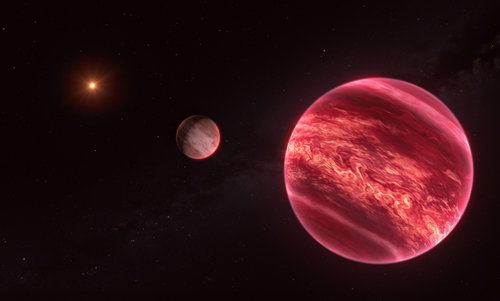
Whether this celestial body, despite having Jupiter-class mass, can be called a "moon" as it orbits a brown dwarf raises scientific considerations. Dr. Kevin Hoeij presented a paradoxical position, stating that "it is difficult to define using solar system terminology," yet "I still want to call it a moon." This suggests that the familiar celestial classification system we know has difficulty encompassing all the diversity of the universe.