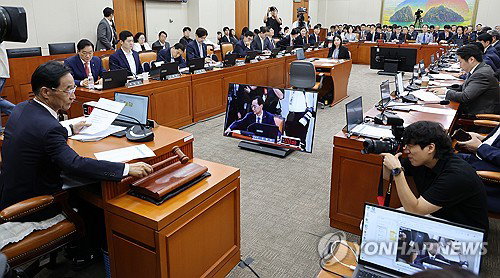
The KOSPI index fell below the 6,000 mark, and as the stock market plummeted for the second consecutive day, the National Assembly's Political Affairs Committee yesterday identified single-stock leveraged ETFs as the culprit, describing the situation as a "financial market collapse" and a "crisis more severe than a financial crisis." Members from both ruling and opposition parties launched fierce accusations against financial authorities.
The domestic stock market entered a state of panic today. The KOSPI index fell below the 6,000 level and continued its sharp decline from the previous day. This has caused investor anxiety to reach an all-time high. At the National Assembly's Political Affairs Committee plenary session held on the 28th, lawmakers from both parties unanimously identified single-stock leveraged ETFs as the core cause of stock market instability and strongly criticized the Financial Services Commission and the Financial Supervisory Service.
The Democratic Party criticized the government's sluggish response and urged the introduction of stronger regulations. Rep. Kim Yong-man pointed out that "the government's ETF measures announced only mid-month came too late." Rep. Park Hong-bae emphasized the severity of the situation and urged that "the basic deposit requirement for ETFs should be raised to 50 million won and adjustments to leverage target ratios should be considered." Rep. Son Myung-soo characterized the current situation as a "financial market collapse without a financial crisis or war" and repeatedly demanded swift and bold action from financial authorities.
The People Power Party raised suspicions that there was a political background in the process of introducing ETF products and mounted even stronger pressure on financial authorities. Rep. Song Eon-seok raised strong suspicions, asking, "Wasn't this pushed through hastily to help with the June 3 local elections?" Reps. Park Dae-chul and Shin Dong-wook characterized the current situation as a "man-made disaster" caused by the Financial Services Commission and Financial Supervisory Service, criticizing it as "more serious than a financial crisis." Reps. Shin Dong-wook and Park Sung-hoon went further, calling for the "resignation of the FSC chairman and FSS governor," while demanding a "national investigation" into the background of ETF introduction and the approval process, making an all-out move.