As AI emerges as a 'geopolitical weapon' that determines national competitiveness and security, countries around the world are engaged in multifaceted diplomatic maneuvering for survival and sovereignty amid the US-China hegemonic competition. On July 21, EU Executive Vice President Henna Virkkunen emphasized in a Financial Times interview that "AI has become a geopolitical weapon that can shake the economy and security of other countries."
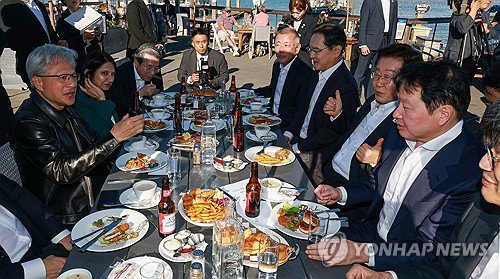
Amid this turbulent situation, South Korea is solidifying its 'AI alliance' with the United States while securing technological sovereignty. President Lee Jae-myung met with US President Joe Biden at the 'San Francisco AI Summit' held during a state visit on July 24, establishing the foundation for an AI alliance. The gathering included major business leaders such as Samsung Electronics Chairman Lee Jae-yong, SK Chairman Chey Tae-won, Hyundai Motor Group Chairman Chung Euisun, and Naver Board Chairman Lee Hae-jin, highlighting South Korea's strengths in memory semiconductors, a critical bottleneck in the AI value chain. Policy Chief Kim Yong-bum emphasized the strategic importance of the Korea-US AI alliance.
As the Korea-US alliance strengthened, China immediately moved to counter it. Chinese state media expressed concerns about South Korea's alignment with the US, arguing for the necessity of cooperation alongside claims about the impossibility of isolating the Chinese market. The US strengthened pressure on China by announcing an import ban on Chinese-made advanced humanoid robots and other items on July 28 to protect its AI supply chain. Amid deepening US-China tensions, Japan is actively securing its position by strengthening AI and semiconductor cooperation with US and Taiwanese companies, following NVIDIA CEO Jensen Huang's visit in June.
Europe, feeling a sense of crisis from its high dependence on the US AI ecosystem, also extended a hand to South Korea. In June, Europe painfully realized the reality of "leaving the switch in Washington's hands" when the US controlled overseas use of Anthropic's high-performance AI models. The 'Europe 2031' report designated South Korea, along with Japan, as an important country in the AI hardware supply chain and proposed solidarity. Europe is accelerating the implementation of 'Sovereign AI' with a goal of capturing 20% of the global semiconductor market by 2030. Just as Netherlands' ASML secured its global status through bottleneck technology in semiconductor lithography equipment, Europe has recognized the importance of critical bottleneck technologies in the AI era. Within this context, Samsung Electronics is reviewing a maximum investment of 1 billion euros (approximately 1.65 trillion won) in French AI model company Mistral, opening possibilities for cooperation with Europe.