The Industrial Research Institute has warned that as US-China technological competition shifts to a phase of controlling AI standards and global production order based on manufacturing foundations, China's offensive in AI and supply chains is intensifying. In particular, China's share of 12-inch wafers is projected to reach 32% by 2026, and shocking figures have become reality with China accounting for over 88% of global humanoid robot shipments last year (2025), leading the institute to recommend that Korean manufacturing urgently develop strategies to secure 'irreplaceability' beyond being a simple component supplier.
The US semiconductor export controls have paradoxically accelerated China's self-reliance in semiconductors and AI ecosystems. Huawei is establishing its own architecture and promoting localization of materials, components, equipment, and memory while completing a self-sufficient semiconductor ecosystem. China's global share of 12-inch wafers is expected to skyrocket from 3% in 2020 to 32% this year—more than a tenfold increase—and Changxin Memory (CXMT) has emerged as the world's fourth-largest DRAM company. As Chinese open-source AI models including DeepSeek continue to be released, China is upgrading traditional manufacturing through AI and strategically assetizing it.
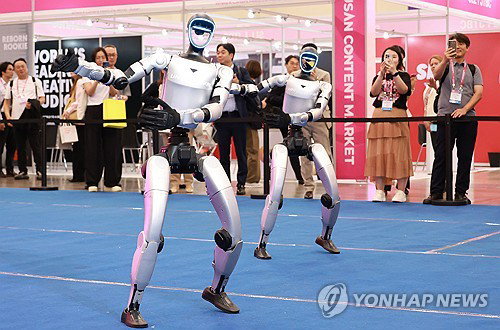
In particular, China is securing an overwhelming advantage in the Physical AI sector. China accounted for over 88% of global humanoid robot shipments last year (2025), securing its own work standards and leading global standard-setting. On June 10, 2026, Unitree AI robots were demonstrated at the Busan BCM, and on July 21, robot screw-tightening operations were showcased at Shanghai WAIC, displaying technological capabilities.
Faced with this situation, Korean manufacturing is at risk of remaining a simple component supplier. The Industrial Research Institute emphasizes that securing 'irreplaceability' in manufacturing is key to Korea's survival and insists that a paradigm shift for redesigning autonomous status is necessary. As solutions, it proposes building Korea-specific large language models (LLMs) for manufacturing using Korea's unique tacit knowledge and data in semiconductors, steel, and shipbuilding, and completing a 'K-Manufacturing Architecture' combined with existing manufacturing strengths.