Chairman Wash's remarks came shortly after the U.S. Department of Labor announced on the same day that the Consumer Price Index (CPI) for June declined and core inflation, excluding food and energy, essentially remained flat.
The market outlook suggested that this price indicator could ease the possibility of additional rate hikes that some Fed officials had recently raised.
However, Chairman Wash drew a line, saying judgment should not be based on a single economic indicator.
He stated, "Some people may look at today's released indicators and think 'the mission is accomplished and everything is fine,' but that is not my view."
▲ Refrains from Comments on Interest Rate Direction…Minimizes Policy Signals
Chairman Wash refrained from making specific comments on future interest rate direction.
He maintained the Fed's existing position that it is not desirable for the central bank to pre-signal its next policy direction to the market, and did not provide clear criteria for when high inflation is judged as "persistent price increases."
Chairman Wash expressed confidence that the Fed's objective is clear and that inflation will stabilize if policy is implemented correctly.
He stated, "If we operate our policy correctly, and we will certainly do so, the surge in inflation that has continued over the past five years will become a thing of the past."
▲ "Prices are a Result of Policy"…Emphasizes Fed Responsibility
When lawmakers asked about specific countermeasures, Chairman Wash acknowledged the realistic limitations facing the central bank while emphasizing that ultimate responsibility lies with the Fed.
He explained that among the factors driving up prices, such as overseas conflicts, there are elements that the Fed cannot directly control.
However, he stated, "Inflation is ultimately a matter of policy choice," and "monetary authorities must choose lower prices."
▲ Capable of Responding with Interest Rates and Asset Size
Chairman Wash explained that the Fed has sufficient policy tools, including adjusting the benchmark interest rate and controlling the size of assets held.
He emphasized that in the current situation, we must not evade responsibility by blaming only external factors.
Lawmakers asked why, unlike previous Fed chairs, the Fed is not providing specific guidance on future policy direction.
In response, Chairman Wash explained that if the central bank presents economic outlooks too specifically, it can fall into the error of accepting only information that matches existing forecasts and ignoring information that does not.
He stated, "A somewhat more cautious and restrained approach helps us judge the situation more objectively."
▲ Promises to Maintain Independence Despite Political Pressure
Chairman Wash, who served as a Fed board member from 2006 to 2011, rejoined the Fed in May of this year.
Before he took office, President Trump publicly demanded rate cuts, attempted to remove Fed Governor Lael Brainard, and also pursued a Department of Justice investigation into his predecessor Jerome Powell, exerting strong political pressure on the Fed.
President Trump considered Wash as a Fed chair candidate in 2017 but ultimately chose Powell. Subsequently, he publicly stated that he would not consider anyone unwilling to agree with his interest rate cut stance as Fed chair.
▲ "Interest Rates Decided by Economics, Not Politics"
Chairman Wash emphasized that the Fed's independence is secured through policy outcomes, separate from these political controversies.
He assessed that over the past five years, the Fed's failure to achieve price targets has expanded room for political intervention.
In response to questions from both Democratic and Republican lawmakers, he repeatedly promised to decide interest rates based solely on economic conditions without political considerations.
▲ Possibility of Additional Rate Hikes Still Remains
The market has raised the possibility that the Fed may proceed with additional rate hikes to stabilize prices.
Last year, the Fed cut rates three times due to concerns about labor market slowdown, but the anticipated economic recession did not materialize.
Employment remained stable and the unemployment rate remained largely unchanged, and the slowdown in economic activity that was previously feared did not occur.
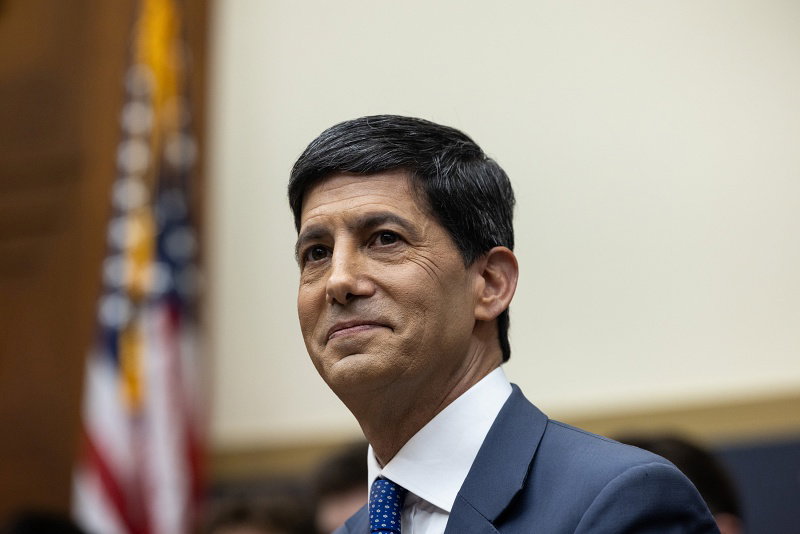
Federal Reserve Chairman Kevin Wash (Photo: [EPA/Yonhapnews])
▲ Tariffs, Middle East War, AI Investment…New Inflationary Pressures
Instead, the U.S. economy faces three new inflation factors.
As import tariff increases, energy and raw material price increases due to war in Iran, and expanded AI infrastructure construction simultaneously stimulate prices, inflation has remained stuck at levels above 3% depending on the indicator.
▲ Interest Rate Hike Argument Spreads Within Fed
Christopher Waller, a Fed governor who led rate cuts last year, recently evaluated that while inflation may improve, if prices do not stabilize consistently, additional rate hikes should be considered.
He emphasized, "We cannot just wait for prices to fall on their own."
▲ Pursuing Complete Overhaul of Fed Operating System…"Reform Will Not Compromise Transparency"
Chairman Wash also disclosed at this hearing plans to completely overhaul the Fed's policy decision-making process, economic analysis system, and public communication methods.
To this end, he explained that five task forces involving external experts were launched last week.
Some have raised concerns that task force operations and the Fed's reduced external communications could diminish transparency.
However, Chairman Wash stated that the results of each task force will first be reported to the Federal Open Market Committee (FOMC) and then fully disclosed to the public, saying "nothing will be conducted in secret."
▲ "Past Policy Failures Led to Current Inflation"
Chairman Wash evaluated that changes in the Fed's academic and policy framework have ultimately led to current high inflation.
He stated, "These policies caused the greatest damage to society's vulnerable," and emphasized, "This is precisely why Fed reform is necessary."
One of the newly launched task forces is expected to research how to utilize advanced technologies, including AI, in central bank policy analysis.
Chairman Wash also evaluated at this hearing that expanded AI infrastructure may increase the U.S. economy's growth rate while not necessarily causing inflation.
However, he stated, "Since it may take considerable time for long-term effects to appear, we must carefully monitor the situation on a monthly and quarterly basis," emphasizing the need for a cautious approach.
Copyright © JKN. Unauthorized reproduction or redistribution prohibited.