Our economy continues its recovery, led by strong exports.
With significant increases in semiconductor, computer, and shipbuilding exports, June exports rose 70.9% compared to the same month last year, and consumption also showed signs of recovery, sending positive signals across the broader economy.
The Ministry of Finance and Economy diagnosed in the July edition of "Recent Economic Trends" (Greenbook) released on the 15th that "our recent economy shows signs of solidifying economic recovery momentum."
Industrial production saw a slight decline due to weakness in manufacturing, and recovery did not spread to all sectors.
In particular, while production in the service and construction sectors increased, production in the manufacturing sector declined, resulting in overall industrial production decreasing by 0.3% from the previous month. This shows that increased exports are not directly translating into expanded production.
Analysis showed that as global demand recovery continues alongside production adjustments in some industries, there is a temperature gap in the pace of economic recovery.
While the Consumer Sentiment Index (CSI) rose, the Corporate Business Sentiment Index (CBSI) declined in both performance and outlook.
This meant that households expect economic improvement while businesses remain concerned about external uncertainty and cost burdens.
Leading economic indicators rose, but coincident indicators fell, requiring additional confirmation on whether the recovery phase will lead into full expansion.
▲ Signs of Recovery in Private Consumption, Facility Investment, and Construction Investment
Private consumption in the first quarter grew 0.6% from the previous quarter, continuing its recovery trend.
May retail sales also increased slightly due to improved semi-durable and non-durable goods.
Increased domestic car sales in June and improved consumer sentiment are positive signals.
Facility investment recorded a large increase of 6.6% in the first quarter, but the May index saw a slight decline.
Increased machinery orders are expected to support future investment.
Construction investment increased slightly in the first quarter, but despite improved orders, uncertainty remains with factors such as declining permit areas.
![[Courtesy of Yonhapnews]](https://images.jkn.co.kr/data/images/full/101/82/1018212.jpg?width=1200 "[Courtesy of Yonhapnews]")
[Courtesy of Yonhapnews]
▲ Employment Recovery Signals Emerge, Yet Quality Job Creation Remains a Challenge
June employment increased by 63,000 compared to the same month last year, reversing the May decline of 40,000 to show growth.
However, the employment rate fell 0.2 percentage points from last year, and industry trends were mixed. Service sector employment expanded, but manufacturing and construction continued declining.
In particular, manufacturing employment continued its downward trend, and construction employment also saw a larger decline due to weakening real estate market conditions.
Meanwhile, service sectors such as healthcare and welfare led employment growth, driven by aging demographics and expanded care demand.
Youth employment difficulties remain an issue to be solved.
Employment of those aged 15-29 continued to decline, and the economic participation rate also fell.
The unemployment rate remained at 2.8%, the same as last year, but the economic participation rate fell as the non-economically active population increased.
▲ Price Increase Pressures Persist...Perceived Inflation Higher
June consumer prices rose 3.2% year-over-year, widening from 3.1% the previous month.
The impact was largely due to price increases in agricultural and fishery products and expanded increases in livestock products. Oil prices also surged 24.7% due to sustained high global oil prices.
Core inflation also recorded 2.5%, showing that price increase pressures remained widespread.
The living cost index rose 3.4%, indicating that price burdens perceived by consumers in daily life were greater than official consumer prices.
While dining-out prices remained relatively stable, personal service prices excluding dining-out maintained high levels, increasing household burdens.
Core inflation excluding food and energy remained stable at 2.5%.
The living cost index also rose 3.4%, raising consumers' perceived inflation.
International oil prices declined following the ceasefire agreement between the United States and Iran, but with geopolitical uncertainty not fully resolved, energy price volatility is expected to remain in the future.
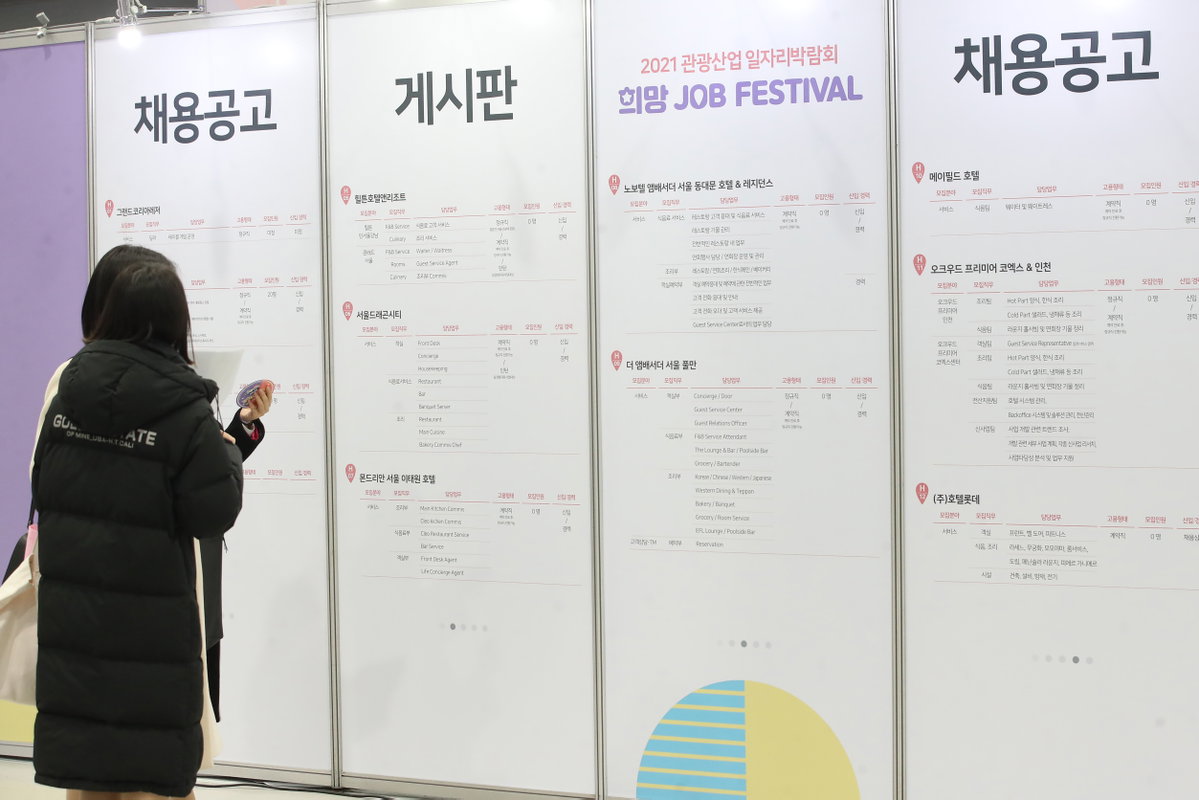
Recruitment[Courtesy of Yonhapnews]
▲ Fiscal Policy Supports Economy...Fiscal Soundness Management Continues
Government finances continued to support economic recovery.
As of May, the managed fiscal balance recorded a deficit of 54.2 trillion won, down 10 million won from the same period last year.
The consolidated fiscal balance also improved to a deficit of 23.4 trillion won. This was thanks to increased revenue exceeding increased spending.
The overall spending execution rate also recorded 46.9%, showing that first-half fiscal spending proceeded as planned.
Fiscal expansion acts positively in supporting economic recovery, but in the long term, it also carries challenges of increased national debt and fiscal soundness management.
▲ Recovery Momentum Continues, but External Variables Remain
The government assessed that economic recovery momentum is solidifying based on expanded first-quarter growth, strong exports, and improved consumption.
However, the aftermath of Middle East regional conflicts continues to burden people's livelihoods through price increases and employment slowdown, and the global economy also faces risk factors including growth slowdown and energy price uncertainty.
Ultimately, our current economy has entered a phase where exports are leading recovery, but domestic demand, employment, and inflation in people's livelihood areas have not yet reached a complete recovery stage.
The sustainability of future economic recovery is analyzed to depend on whether strong export performance translates into investment, production, and quality job creation, and whether price stability can be achieved simultaneously.
Copyright © JKN. Unauthorized reproduction or redistribution prohibited.