The National Tax Service has begun earnest efforts to transform itself into an "integrated fiscal revenue institution" that manages not only tax collection but also non-tax state revenues scattered across various government agencies.
The plan is to expand the agency's role beyond simple tax administration to manage the entire scope of national fiscal revenues, thereby increasing fiscal efficiency.
On the 15th, National Tax Service Commissioner Lim Kwang-hyun announced in a presidential briefing that starting next year, the NTS will integrate collection of non-tax state revenues that are currently dispersed across approximately 300 laws.
To achieve this, the NTS will support revisions to related laws and establish a system to integrate delinquent tax information through information sharing among government agencies.
Once non-tax state revenues are linked in real-time with the NTS administration system, it is expected that delinquency management efficiency will increase significantly.
The NTS explained that it has already confirmed the effectiveness of integrated collection during the pilot operation phase.
Commissioner Lim stated that when payment notices for police traffic fine delinquencies were sent under the NTS name, daily payment amounts jumped from an average of 1.2 billion won to 3.8 billion won in a single day, causing police servers to temporarily crash due to the sudden influx of payments.
▲ Large-scale delinquency management begins...operating 10,000-member delinquency management team
The NTS has decided to establish a large-scale delinquency management system.
From the second half of this year, the NTS plans to operate a delinquency management team of 10,000 members to systematically manage delinquencies totaling approximately 130 trillion won.
Through the first round of recruitment, 5,500 people have already been hired, with young people in their 20s and 30s making up 41.8% of the total, thereby achieving youth employment creation effects.
President Lee Jae-myung actively ordered the expansion of the delinquency management team.
He stated that strengthening delinquency management brings two simultaneous effects: increased non-tax revenues and job creation, and emphasized that if necessary, additional personnel should be hired to raise awareness about tax evasion.
This went beyond simply collecting delinquent taxes and was interpreted as a policy that also considers strengthening the national financial foundation and youth employment.
▲ Expanding investigations to ultra-luxury homes...targeting anti-social tax evasion
The NTS decided to further strengthen investigations into anti-social tax evasion from the second half of the year.
While continuing investigations into existing price-distorting evasion, stock market fraud evasion, and offshore evasion, the NTS will expand its crackdown on private misappropriation of corporate funds.
In particular, the so-called "imperial executive residences," where corporate-purchased ultra-luxury homes are used free of charge by executives as personal residences for extended periods, have been selected as priority investigation targets. The NTS plans to expand its investigation scope beyond supercars to ultra-luxury real estate to eliminate private misappropriation of corporate assets.
This is interpreted as reflecting a strong will to firmly respond to acts that go beyond simple tax evasion and undermine tax equity while fostering national feelings of deprivation.
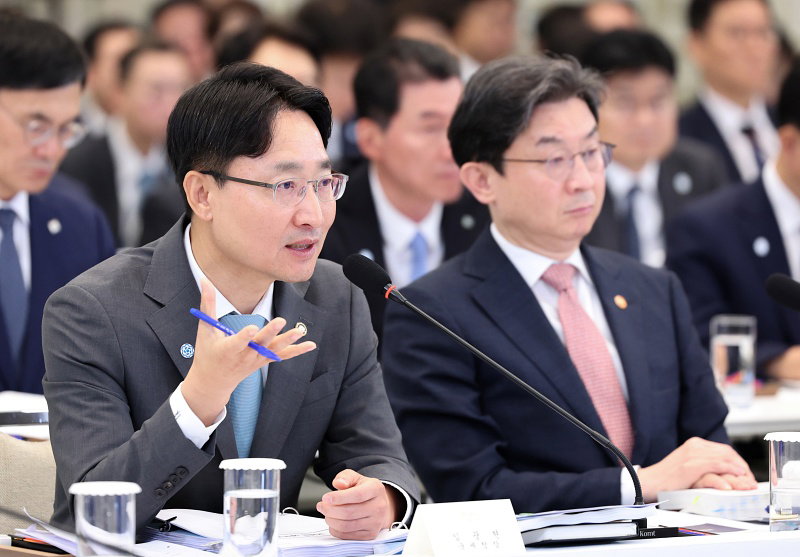
NTS Commissioner Lim Kwang-hyun delivers work briefing (Photo : [Courtesy of Yonhapnews])
▲ Tracing real estate tax evasion and overseas hidden assets
The NTS decided to maintain a high-intensity response to real estate tax evasion.
The NTS plans to carefully analyze 1,168 reports received at the real estate tax evasion reporting center and intensively investigate various evasion types such as circumventing loan regulations and misuse of business loans.
For malicious high-amount and habitual delinquents, the NTS will pursue collection through civil lawsuits and public auctions, and will also track assets transferred overseas through international cooperation.
This is interpreted as a policy direction to increase penalties for evasion and establish a culture of faithful tax payment.
▲ Expanding tax support...focusing on easing polarization
The NTS decided to strengthen not only enforcement but also tax support functions.
For young entrepreneurs, the NTS plans to introduce "Startup Tax Care," support regional economic vitalization through dedicated tax consultation for companies relocating to regions and expansion of tax investigation grace periods for regional businesses.
The NTS will also extend the tax audit grace period for small merchants with less than 1 billion won in sales until the end of the year and newly operate an "Overseas Market Development Tax Support Team" to support SMEs' international expansion.
This is evaluated as showing that tax administration is expanding its role beyond a simple collection agency to serve as a policy agency supporting corporate growth and regional economies.
▲ Full-scale AI tax administration...digital transformation of tax administration
The NTS decided to accelerate innovation in tax administration using artificial intelligence.
The NTS plans to develop an AI tax evasion detection system that automatically analyzes tax evasion possibilities with only basic corporate information input, and implement digital tax payment services at a level that citizens do not need to visit tax offices directly.
This is interpreted as a strategy to simultaneously automate repetitive tasks and increase the accuracy of tax evasion detection while improving administrative efficiency and tax payment convenience.
This NTS work briefing focused on expanding its function from a traditional role as a tax collection agency to a platform that integrates national fiscal revenues.
By significantly broadening its policy scope—from integrated non-tax revenue collection and strengthened delinquency management to elimination of anti-social tax evasion, AI-based tax administration innovation, and expanded tax support—it presented a direction to simultaneously pursue fiscal security and economic vitalization.
Copyright © JKN. Unauthorized reproduction or redistribution prohibited.