U.S. President Donald Trump has decided to impose an additional 50% tariff on certain Canadian products, escalating trade tensions between the United States and Canada.
The measure was announced while renegotiations of the U.S.-Mexico-Canada Agreement (USMCA) are underway, and is expected to have a significant impact on negotiations between the two countries.
▲ 50% Additional Tariffs on Wine, Hockey Sticks, and Cement
According to the Wall Street Journal on the 20th (local time), the White House announced it will impose an additional 50% tariff on specific Canadian imports, including wine, hockey sticks, and cement.
However, the White House explained that certain strategic items such as energy, potassium fertilizer (potash), seafood, and critical minerals are excluded from this measure.
The new tariffs will take effect 30 days after signing and are expected to apply to approximately $20 billion worth of Canadian products.
▲ Emphasizing "Response to Discrimination Against U.S. Products"
The White House stated that this measure is in response to Canada's discriminatory policies against U.S. products.
The U.S. government pointed out that Canada operates policies requiring automotive companies to invest in manufacturing facilities in Canada rather than the United States, and that some provincial governments ban the sale of U.S. alcoholic beverages.
The White House explained that these policies are placing unfair burdens on U.S. companies, and the additional tariffs are measures to offset this.
▲ Impact Limited Compared to Total Import Volume
The United States imported approximately $383 billion worth of Canadian products during 2025.
While the target of these additional tariffs represents only a portion of total imports, analysts noted that it carries significant symbolic meaning in bilateral trade relations.
In particular, this measure has been analyzed as an example showing that conflicts between the two countries over USMCA, which is undergoing renegotiation this year, are deepening.
▲ Canada "Unilateral Action...Violates Agreement" Opposes
Canadian Prime Minister Mark Carney criticized the additional tariffs as another unilateral trade measure by the United States.
In a statement, Prime Minister Carney argued that this measure violates the USMCA and said that Canada has presented specific negotiation proposals multiple times to resolve bilateral trade issues.
He stated, "The citizens of both countries suffer the most from this trade dispute, with the burden particularly increasing for American consumers," adding that "Canada is ready to actively engage in negotiations for mutual benefit."

Trump Imposes 50% Additional Tariff on Some Canadian Products (Photo : [Reuters/Yonhapnews])
▲ USMCA Renegotiation Also Expands Uncertainty
President Trump has repeatedly mentioned publicly the possibility of terminating USMCA.
U.S. Trade Representative Jamieson Greer also suggested that the option of separating the three-country agreement between the United States, Mexico, and Canada into bilateral agreements between the U.S.-Mexico and U.S.-Canada could be considered.
The U.S. and Mexico are scheduled to conduct official negotiations this week, but the U.S. and Canada have not yet begun substantive negotiations.
▲ USMCA-Compliant Products Also Included in Tariff Targets
This measure has characteristics different from existing tariffs on Canada.
The White House stated that these tariffs will apply to products that meet USMCA standards.
However, it is known that if official negotiations between the U.S. and Canada begin in the future, there remains a possibility that President Trump could withdraw the tariffs before they take effect.
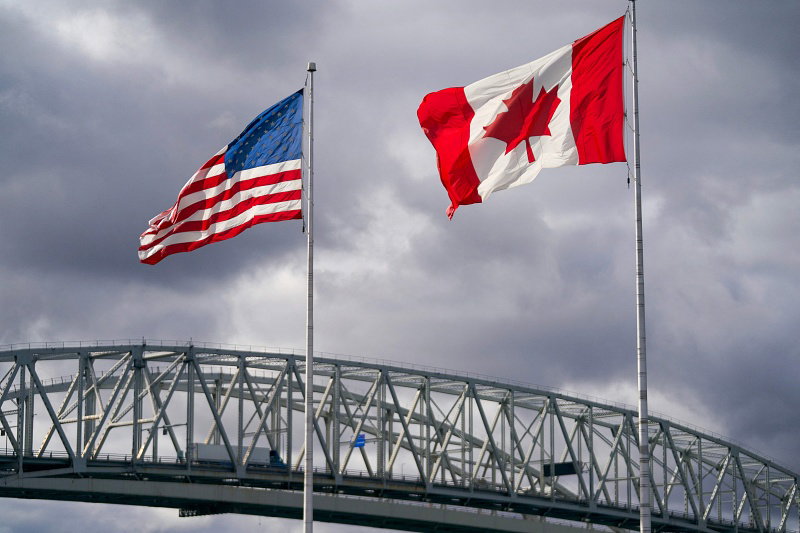
U.S. and Canadian Flags (Photo : [AFP/Yonhapnews])
▲ Separate from Existing Tariffs
Last year, President Trump imposed tariffs on Canada based on a national emergency declaration, citing Canada's involvement in fentanyl distribution, but the U.S. Supreme Court ruled in February this year that the measure was unlawful.
Additionally, the U.S. applies separate tariffs on Canadian steel, aluminum, auto parts, and lumber under the justification of national security.
The White House explained that these additional tariffs will not be applied twice to products already covered by existing national security tariffs.
▲ Canada Also Hints at Possibility of Retaliatory Tariffs
Canada withdrew a significant number of retaliatory tariffs on U.S. products that it had imposed last year, but some provincial governments still ban the sale of U.S. wine and spirits.
Doug Ford, the Premier of Ontario, urged reciprocal retaliatory measures at the same level, saying "tariffs should be met with tariffs, dollars with dollars" if the U.S. proceeds with additional tariffs.
▲ Using Wildfire Smoke as Justification for Tariffs
This measure was announced after Canadian wildfire smoke recently spread to the eastern and midwest regions of the United States.
As major cities including New York, Chicago, and Washington D.C. were affected by wildfire smoke, President Trump warned last week via his social media platform Truth Social that he could impose higher tariffs, saying Canada is not properly managing its forests.
He strongly claimed responsibility on the Canadian government, saying "due to Canada, the United States is being polluted and exposed to unhealthy air."
▲ World Cup Final Also Brings Up Wildfire Issue
President Trump reportedly mentioned the wildfire issue when meeting with Prime Minister Mark Carney at the FIFA World Cup final on the 20th.
He subsequently told reporters, "I told Canada that it must stop wildfires," adding "U.S. air is polluted. The U.S. could help if necessary, but Canada may have to pay damages or bear tariffs."
▲ First Use of 1930 Trade Law...Legal Controversy Expected
These tariffs are implemented based on Section 338 of the U.S. Trade Act of 1930.
This provision allows the president to impose tariffs on nations that discriminate against U.S. companies, but there have been no actual cases of applying tariffs based on this clause until now.
Ryan Majerrus, an attorney at King & Spalding, predicted that this measure is likely to face legal lawsuits if implemented.
The market analyzed that these additional tariffs could go beyond simple trade measures and affect the entire North American trade order.
In particular, if conflicts between the U.S. and Canada intensify amid USMCA renegotiations, there are concerns that uncertainty in the entire North American supply chain, including automobiles, manufacturing, agricultural products, and energy, could expand.
Copyright © JKN. Unauthorized reproduction or redistribution prohibited.