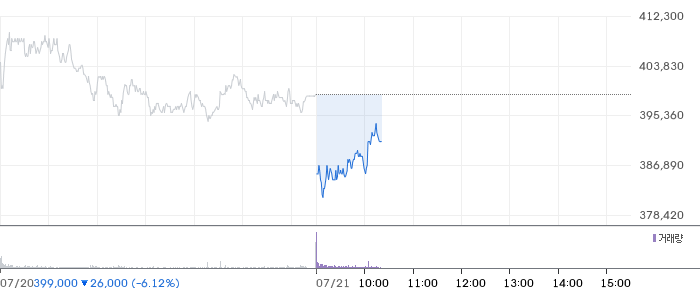
Hyundai Motor continued its weakness on the 21st and is currently trading at 392,000 won. This represents a decline of 7,000 won (-1.75%) compared to the previous trading day. Despite recently announced executive stock ownership reports and notices regarding investor relations briefings, overall investment sentiment appears to be dampened.
Hyundai Motor's stock price (005380) failed to escape the downtrend and recorded weakness throughout the trading session. In the KOSPI market, selling pressure from institutional and foreign investors is identified as pushing down the stock price. The recently announced "Executive and Major Shareholder Securities Ownership Report" failed to act as significant positive news for the market, and the subsequently announced "Investor Relations (IR) Briefing Notice" similarly did not serve as a catalyst for a short-term stock price rebound. While the disclosure content itself is neutral, market interpretation appears to be taking a conservative stance.
Concerns about global economic slowdown, intensifying competition in the electric vehicle market, and rising raw material price pressures are identified as complex factors weighing on investment sentiment across the automotive industry. Hyundai Motor shows positive aspects by proactively pursuing an electric vehicle transition strategy and expanding market share, but uncertainty in the macroeconomic environment continues to fuel investor anxiety. In particular, there are concerns that if high interest rates persist, the possibility of reduced automobile sales due to weakened consumer sentiment cannot be ruled out, and this could increase valuation burdens.
Some analysts view Hyundai Motor's recent sharp uptrend as temporarily overheated, with profit-taking sales appearing in the market accordingly. A securities industry official stated, "In a situation where there is uncertainty regarding second-half earnings guidance, investors are increasingly inclined to realize profits due to risk-averse sentiment." This conservative approach is acting as a factor in amplifying short-term stock price volatility.