The Chinese government strongly pushed back against the United States' investigation and potential sanctions on its artificial intelligence (AI) companies, criticizing what it called "AI hegemony."
As the U.S. considers sanctions against Chinese companies over allegations of unauthorized use of American AI technology, tensions between the two countries over AI technology are intensifying.
▲ China's Commerce Ministry: "Pressuring Companies with Unfounded Accusations"
According to Reuters on the 27th (local time), China's Ministry of Commerce said in a statement that if the U.S. is pursuing investigations and sanctions based on allegations that Chinese AI companies replicated advanced American AI models using the "distillation" technique, such claims lack factual and legal basis.
The ministry argued that the U.S. is threatening punishment of Chinese companies without sufficient evidence, which it said is an act that hinders normal market competition.
▲ "All Necessary Measures If China's Interests Are Harmed"
The Chinese government indicated a hardline stance in response to the possibility of additional U.S. sanctions.
A Commerce Ministry spokesperson emphasized: "China will resolutely take all necessary measures to protect its legitimate rights and interests against any measures that cause substantial harm to China's interests."
▲ Moonshot AI's 'Kimi K3' at Center of Controversy
At the center of this conflict is Moonshot AI, an AI startup headquartered in Beijing.
Moonshot AI's recently released large language model (LLM) "Kimi K3" has drawn attention for its outstanding programming capabilities, and this has sparked a broader debate in the U.S. over whether Chinese companies have replicated American AI models or whether they are rapidly narrowing the technology gap through their own research and development.
Analysts note this follows a similar pattern to concerns raised in the U.S. when Chinese AI startup DeepSeek emerged last year.
▲ U.S.: "Large-Scale Distillation of Anthropic Models"
Michael Kratsios, director of the White House Office of Science and Technology Policy (OSTP), said last week that the U.S. government has obtained information that Moonshot AI developed Kimi K3 by using distillation methods on Anthropic's latest AI model, "Claude Fable 5."
He claimed that Moonshot AI built an internal platform for large-scale distillation of American AI models and alternated various approaches to avoid detection.
He also alleged that Moonshot AI obtained servers equipped with Nvidia's GB300 AI chips and has access to systems located in Thailand, which it used for model training.
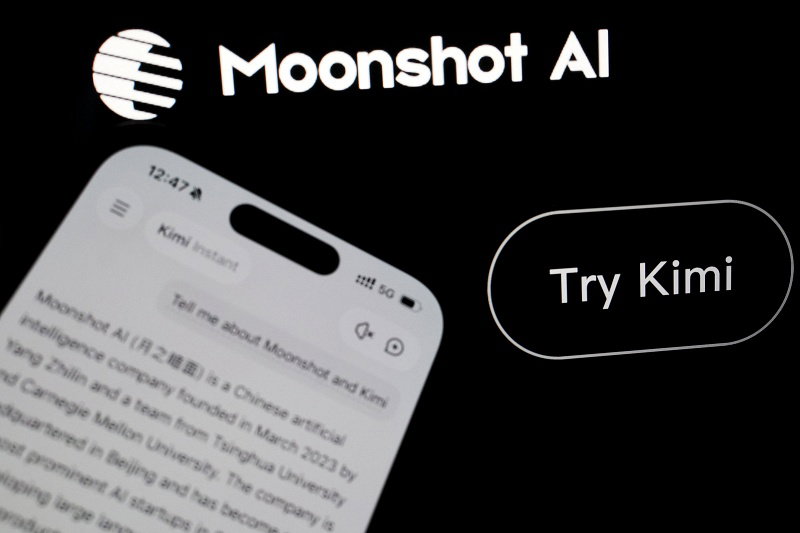
Moonshot AI(Photo : [Reuters/Yonhapnews provided])
▲ U.S. Considers Financial Sanctions and Export Controls
U.S. Treasury Secretary Scott Bessent warned that Chinese AI companies could face financial sanctions or be included on the Commerce Department's "Entity List" for export controls.
He said on social media platform X: "The U.S. supports open-source AI and innovation through it, but open-source does not mean unauthorized use of American intellectual property (IP)."
He added: "If a Chinese company conducts covert industrial-scale distillation attacks that constitute intellectual property infringement, sanctions and Entity List designation will be considered."
▲ Moonshot AI: "Performance Improved Through Independent Technology"
Moonshot AI completely denied the U.S. allegations.
The company said last week through Chinese business media National Business Daily that Kimi K3's performance resulted from independently improving the basic architecture of AI models, not from distillation techniques.
▲ Entity List Designation Would Inevitably Inflict Damage
Experts analyzed that if Moonshot AI is actually included on the Entity List, its access to U.S.-made semiconductors, software, and cloud services could be significantly restricted.
Since 2019, the U.S. has placed Huawei on the Entity List and strengthened its technology regulations against China by restricting access to advanced semiconductors and critical technologies.
▲ Anthropic: "Confirmed Over 3.4 Million Suspected Activities"
Meanwhile, Anthropic said in February that it confirmed over 3.4 million usage records of its Claude model that are estimated to be connected to Moonshot AI.
The company said it identified circumstances where hundreds of fake accounts intensively utilized various AI functions including inference, programming, data analysis, tool utilization, computer vision, and remote computer control.
Copyright © JKN. Unauthorized reproduction or redistribution prohibited.