Elon Musk, CEO of Tesla, has been preparing for years to separate China operations from U.S. operations in preparation for geopolitical risks.
Recently, with the possibility of a merger with SpaceX being discussed, various scenarios including spin-off, sale, and closure of China operations are reportedly being reviewed internally. Analysts note that this could have significant impact on Tesla's corporate value, global supply chain, and U.S.-China relations.
▲ Pursuing 'Tesla Bifurcation' in Preparation for U.S.-China Conflict
According to the Wall Street Journal and sources on the 30th (local time), Musk has instructed executives in recent years to draw a "laser" between U.S. and China operations, thoroughly separating the two businesses.
This was a strategy to ensure that at least the U.S. operations could survive independently even if geopolitical conflict breaks out between the U.S. and China.
Internally, it is reported that organizational restructuring was prepared with consideration for the possibility of military conflict that could occur between 2026-2027.
▲ Reviewing Spin-off, Sale, and Closure of China Operations
Recently, some Tesla executives reportedly received instructions to prepare for separation of China operations ahead of a potential merger with SpaceX.
The company's advisory board also discussed various options including spinning off the China business, as well as sale or business withdrawal, sources said.
However, it remains uncertain how quickly actual separation or sale could proceed, and there remains the possibility that future plans could change, according to those involved.
▲ China Operations Are Key to Tesla's Growth
China operations played a critical role in helping Tesla grow into a stable profitable company and global mass-market electric vehicle manufacturer.
Therefore, separating or selling China operations could have significant impact on the company's performance and corporate value.
In particular, if a merger with SpaceX becomes reality, it is expected to serve as an important variable in corporate valuation.
▲ Possibility of SpaceX Merger Emerges Amid AI-Focused Restructuring
Musk has continuously emphasized the potential synergy between Tesla and SpaceX while restructuring both companies around artificial intelligence.
Since SpaceX raised 86 billion dollars through an initial public offering in June, investor and market expectations for a potential merger of the two companies have grown.
In a recent earnings call, Musk said "I cannot discuss the matter of business combination at an earnings presentation, but it should proceed according to appropriate procedures," without completely denying the possibility.
▲ Reducing China Dependence Is the Core Goal
Musk reportedly recognized Tesla's excessive reliance on Chinese battery cells as the biggest risk factor.
In particular, he was concerned about the possibility of semiconductor supply chain disruptions if China invades Taiwan, and consistently pursued measures to reduce dependence on Chinese lithium iron phosphate (LFP) batteries and TSMC semiconductors.
In fact, Tesla decided to discontinue use of Chinese suppliers in its U.S. factories by 2027. This was reportedly influenced by the U.S.'s anti-China tariff policy and domestic production incentive policy.
During the Trump administration's first term, Tesla pursued "Project Carbon," which involved relocating production bases of Chinese suppliers to Mexico.
This was part of a strategy to structurally reduce dependence on Chinese supply chains, going beyond simply avoiding U.S. tariffs on China.
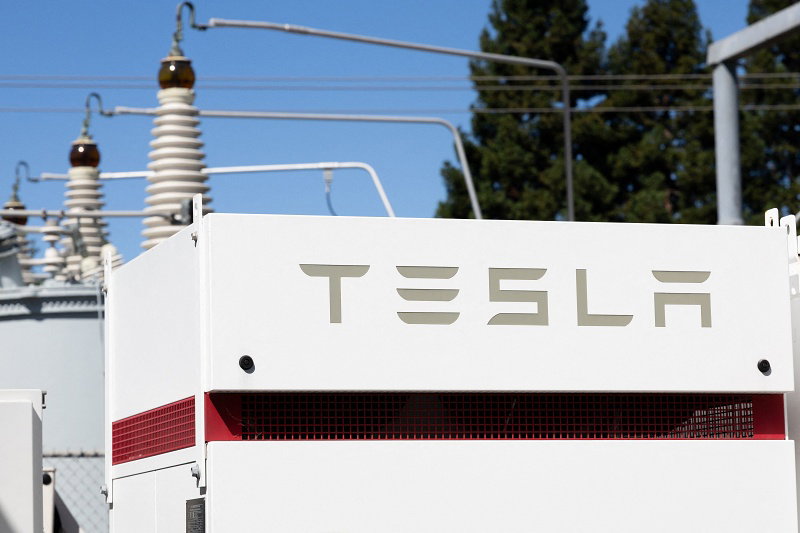
Tesla logo (Photo: [AFP/Yonhapnews])
▲ Potential Conflict with SpaceX's Defense Contracts
Separating China operations also aims to minimize conflicts with SpaceX's U.S. defense industry business.
SpaceX is a key national security contractor for the U.S. government, performing various defense contracts including classified military satellite launches and internet services for the Ukraine battlefield.
As of 2025, the proportion of U.S. government revenue reached 20.9% of total, subject to strict application of export controls and national secrets regulations.
For this reason, analysts argue that if SpaceX acquires or merges with Tesla, the establishment of a strong "firewall" between China and U.S. operations would be essential.
▲ Independent Operation of Shanghai Factory Also Under Review
Tesla is also reportedly considering establishing a separate sales entity responsible for exports of products manufactured at its Shanghai factory.
Additionally, measures to separate office systems to prevent Chinese employees from directly accessing systems of other country business units are also being discussed.
Currently, Tesla's China entity has a certain level of autonomy, but in practice collaborates closely with global organizations, and China chief Tom Zhu oversees global automotive operations.
▲ Enhanced Chinese Government Scrutiny Inevitable
If a merger between SpaceX and Tesla is pursued, stronger scrutiny by the Chinese government is likely to follow.
Concerns could be raised that if a key U.S. defense company controls Tesla's factories, production technology, and supply chains in China, those technologies could be utilized for U.S. military purposes.
Additionally, the possibility that data on approximately 2 million Tesla vehicle users in China could fall under the influence of a U.S. defense company is also a sensitive matter for the Chinese government.
If a merger is pursued, the Chinese government is likely to require separate safeguards to prevent SpaceX from influencing the operations of Tesla's China entity, and measures to prevent technology transfer of dual-use materials such as rare earths, according to analysis.
▲ China's Market Share Remains Substantial
Tesla currently operates two key production facilities in Shanghai: an electric vehicle factory and a battery factory.
Vehicles and batteries produced at these factories are exported to various countries around the world as well as for domestic consumption in China, but are not supplied to the United States.
China is Tesla's second-largest market after the United States, accounting for approximately 18% of total revenue in the first half of 2026.
Additionally, unlike other Western automakers, Tesla operates its China business in the form of an independent entity rather than a local joint venture, which is noted as a distinguishing feature.
▲ Global Companies Also Expanding Separation of China Operations
Experts analyzed that the trend of U.S. companies operating or separating their China operations is becoming increasingly common.
Starbucks recently sold a majority stake in its China business, while Yum Brands spun off its China operations in 2016 and subsequently sold stakes to local investors.
Additionally, major mergers and acquisitions between global companies require approval from regulators in each country, and approval by the Chinese government is also an important variable. In fact, Qualcomm ultimately withdrew its acquisition of NXP Semiconductors in 2018 after failing to obtain approval from Chinese authorities.
Copyright © JKN. Unauthorized reproduction or redistribution prohibited.