A vessel preparing for South Korea's first Arctic route trial voyage is on the verge of departing from Busan Port, but 'geopolitical risks' stemming from Russian sanctions and secondary boycott concerns have emerged as the final hurdle, making it difficult to gauge the prospect of success.
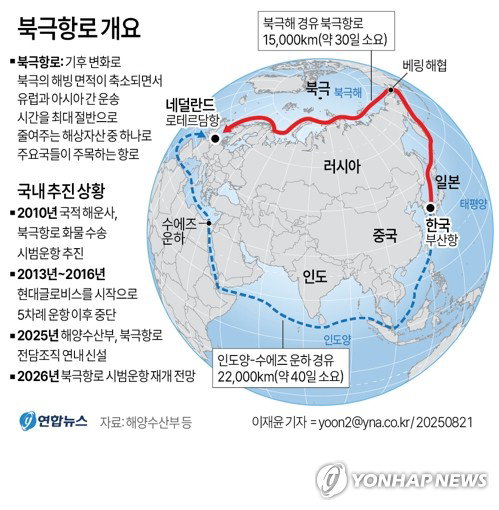
This route would shorten shipping distance by 8,000km (36%) compared to the Suez Canal route, and is particularly gaining value as an alternative route due to Middle East conflicts, while also expected to play a key role in diversifying energy supply chains. It also marks the first step in the government's policy agenda to revitalize Arctic routes.
However, the greatest challenge is the risk of anti-Russian sanctions and secondary boycotts within Russia's exclusive economic zone (EEZ). It is known that final coordination is currently underway between the Western bloc, including the United States.
Initially, geopolitical risks were not expected to be a major obstacle, but recent changes in the international situation are not promising. As anti-Russian sanction bills pending in the U.S. Congress emerge as a variable, tensions have heightened further, particularly with reports that President Donald Trump has shifted his position to support the legislation following Republican Senator Lindsey Graham, a Russia hawk. An incident on July 25th, when an Iranian merchant vessel was attacked by Ukraine in the Caspian Sea, signals a new phase in Middle East conflict and has heightened concerns about intensifying U.S.-Russia confrontation.