The government has decided to significantly expand the scale of the National Growth Fund to strengthen competitiveness in advanced technology and future strategic industries.
The plan is to increase the existing five-year supply plan from 150 trillion won to 200 trillion won to strengthen the foundation for long-term investment in national strategic industries.
The Financial Services Commission announced on the 15th through a presidential briefing that starting next year, it will expand the annual supply scale of the National Growth Fund from the existing 30 trillion won to 40 trillion won. As a result, the total supply scale over the next five years will increase to 200 trillion won.
The scope of support has also been expanded beyond the existing 12 sectors including semiconductors, artificial intelligence (AI), and biotechnology to include new strategic industries such as aerospace. This was interpreted as a strategy to enhance the nation's capacity for long-term investment amid intensifying global technological competition.
In particular, the government expanded direct equity investment from 3 trillion won to 5 trillion won annually to support large-scale projects in key industries. This reflected the intent to reduce the burden of private sector investment by having the government invest together in high-risk, high-growth industries rather than simply providing financial support.
▲ Establishing Long-term Technology Investment Foundation...Launching Strategic Technology Specialized Fund Manager
The government also decided to establish a new long-term technology investment system to improve investment structures focused on short-term results.
By the end of this year, it plans to establish Korea Strategic Technology Partners (KSTP), a specialized fund manager that focuses on concentrated investment in basic technology research and development and localization of core technologies, and supply up to 10 trillion won over the next five years. Additionally, it decided to create a new ultra-long-term technology investment fund of 880 billion won with a duration of over 10 years within the National Growth Fund.
This policy was analyzed as an effort to create an investment ecosystem that aims to secure national competitiveness over short-term returns, given that advanced industries require considerable time from technology development to commercialization.
▲ Expanding Regional Investment...Strengthening Financial Support for Balanced Growth
The government has placed emphasis on financial policy for regional balanced development alongside the cultivation of advanced industries.
In line with the expansion of the National Growth Fund, the government decided to increase regional investment scale from 12 trillion won to 16 trillion won annually and create a new 1 trillion won region-exclusive fund. Additionally, it plans to introduce 'Startup Build-up' guaranteed loans targeting companies within three years of establishment to support initial companies' financing.
The expansion of regional financial supply was evaluated as reflecting the government's policy determination to ease the investment structure concentrated in the Seoul metropolitan area and foster regional strategic industries.
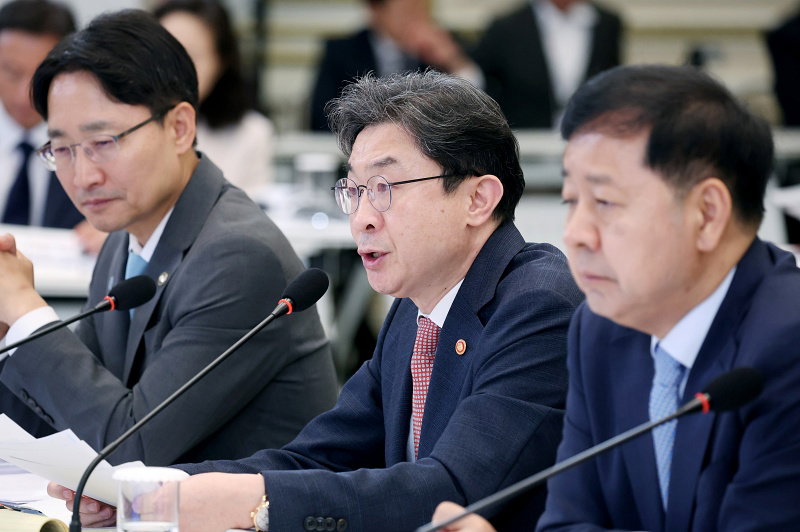
Financial Services Commission Chairman Lee Eok-won delivering a business report(Photo : [Provided by Yonhapnews])
▲ Improving Capital Market System...Enhancing Investor Convenience
The government also decided to pursue institutional improvements to enhance capital market competitiveness.
By October, it plans to prepare a roadmap for implementing the T 1 system, which shortens the stock settlement cycle by one day, with the goal of implementing it in the second half of next year. It also plans to pursue measures for paying interest on public offering subscription deposits and review the appropriateness of loan-to-value loan rates on sale proceeds.
This was interpreted as an institutional improvement to enhance investors' capital utilization efficiency and strengthen the international competitiveness of the domestic capital market.
▲ Expanding Youth Investment Opportunities...Strengthening Startup Support
The government also decided to expand asset formation and startup support for young people.
The second phase of the Citizen Participation Growth Fund, which launches in September, will be composed of 600 billion won in scale with the portion allocated to low-income earners expanded from the existing 20% to 50%. This is expected to significantly broaden young people's investment participation opportunities.
Additionally, for entrepreneurs aged 39 and under, the government plans to create a 200 billion won Promising Young Startup guaranteed loan to reduce interest rates by up to 1.5 percentage points and provide 100% guarantee benefits.
At the same time, it plans to expand credit card issuance using alternative credit ratings for young people and foreigners with limited financial history and strengthen financial education for military personnel. This was analyzed as a policy to increase financial accessibility while supporting sound asset formation.
▲ Strengthening Livelihood Finance...Preventing Illegal Money Lending
The government also decided to significantly strengthen support measures to ease the financial burden on low-income households.
It plans to introduce an 'interest payback' system where users of Sunshine Loan special guarantees can receive part of their interest back if they faithfully repay interest, lowering the effective interest rate from the existing 12.5% to around 6.3%.
Additionally, to prevent the use of illegal money lending, the government has newly prepared low-interest long-term loans with a maximum limit of 1 million won. With an interest rate of 4.5% annually and a maturity extended to 10 years, it plans to address the limitations of existing short-term loans.
The government plans to prevent moral hazard through face-to-face screening and, if necessary, coordinate with welfare services to support the comeback of the financially vulnerable.
Copyright © JKN. Unauthorized reproduction or redistribution prohibited.