Japan's society is facing a complex demographic crisis, recording the largest population decline since 1968 amid stark contrasts: the Japanese population falling below the 120 million mark for the first time in 42 years, while the foreign population surpassed 4 million for the first time in history.
According to data released by Japan's Ministry of Internal Affairs and Communications on July 29, 2026, the number of Japanese nationals as of January 1 was tallied at 119,736,483. The Japanese population has fallen below the 120 million threshold for the first time in 42 years, marking a historic turning point. This is the first occurrence since 1984. This represents a decrease of 916,744 (0.76%) from the previous year, and the declining trend in the Japanese population has continued for 17 consecutive years.
This declining trend stems from deepening low birth rates and aging. Last year, the number of Japanese births reached 670,467, setting a record low, while the number of deaths reached 1,593,475. The natural population decline, calculated by subtracting births from deaths, amounted to 923,008.
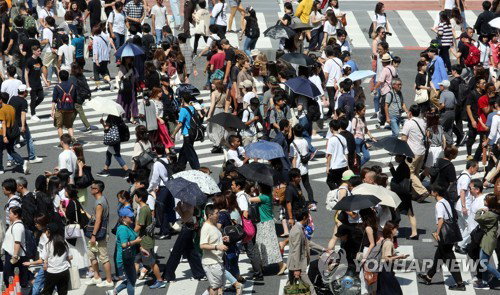
However, another indicator reveals that Japan's demographic landscape is undergoing rapid change. During the same period, the number of foreigners in Japan reached 4,031,159, surpassing 4 million for the first time in history. This represents an increase of 353,696 (9.62%) from the previous year, indicating active foreign immigration.
[Photo=Yonhap News]
However, despite the increase in foreign population, Japan's total population decreased to approximately 123,767,642, down 563,048 (0.45%) from the previous year. Although the foreign population exceeded 4 million for the first time in history, the overall population recorded the largest decline since 1968, intensifying the population extinction crisis. This marks the largest decline since 1968, when related statistics began to be compiled.
The population decline phenomenon is spreading nationwide. Among Japan's 47 prefectures, only Tokyo, the capital, recorded three consecutive years of growth in the Japanese population. Tokyo's Japanese population increased by 12,540 (0.09%), but all other regions showed declining Japanese populations. In particular, Akita Prefecture recorded a decline of 1.95%, while Aomori and Kochi prefectures each showed high decline rates of 1.70%, clearly demonstrating accelerating depopulation crises in local areas. The combined Japanese population of the three major metropolitan areas—Tokyo, Nagoya, and Kansai—accounts for approximately 50% of the total, indicating intensifying population concentration.
Amid rapidly changing demographic landscapes, Japan faces enormous challenges of population decline and regional depopulation. Whether increased foreign immigration can serve as a long-term solution to this population crisis, or whether it will create more complex social problems, remains a challenge that Japanese society must address going forward. This is a time that requires deep reflection on Japan's future.
Copyright © JKN. Unauthorized reproduction or redistribution prohibited.