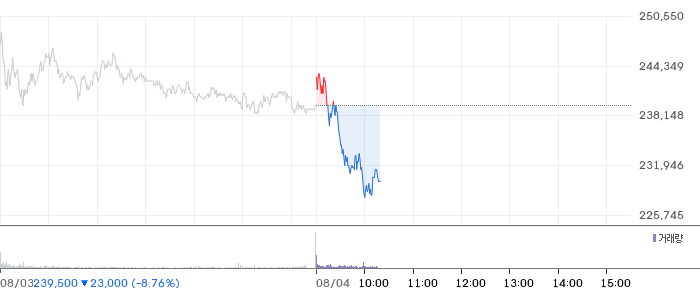
Samsung Electronics (005930) declined more than 3% compared to the previous trading day during today's session, facing downward pressure around the 230,000 won level. Recent disclosures of changes in shareholdings by executives and major shareholders are believed to have dampened investor sentiment and triggered profit-taking sales. Valuation burdens are increasing due to short-term sharp rallies.
Samsung Electronics (005930), the leading stock in the domestic stock market, traded at 230,750 won during today's session on August 4, 2026, recording a decline of 8,750 won (3.65%) compared to the previous trading day. After the 230,000 won level briefly broke this morning, there were attempts at recovery, but selling pressure continues to dominate. This decline is analyzed as a result of recent disclosures of multiple insider trading-related reports, including "Officer and Major Shareholder Specific Securities Ownership Status Reports" and "Major Shareholder Stock Change Notifications," which heightened investor vigilance.
Recent disclosure announcements of shareholding changes by executives and major shareholders over the past seven days have served as a key factor in creating market uncertainty. Generally, share sales by insiders can be interpreted as a signal of declining confidence in stock prices or profit-taking, leading to short-term stock price decline pressure. As multiple disclosures have been successively announced, among investors, skepticism about the growth drivers that have led stock price increases thus far and awareness of market peaks are spreading.
During the session, Samsung Electronics' supply and demand showed a tendency toward selling led by foreign investors and institutional investors. Amid persistent concerns about domestic and international economic uncertainty and short-term volatility in the semiconductor industry outlook, major shareholders' shareholding change disclosures have served as a catalyst, stimulating profit-taking desires. While Samsung Electronics leads the global memory semiconductor market and strengthens its competitiveness in the foundry sector, intensifying competition in the artificial intelligence (AI) semiconductor market and uncertainty about the overall pace of IT demand recovery continue to weigh on stock prices.