The government's latest tax reform plan is focused on significantly increasing tax burdens not only on multi-property owners but also on ultra-luxury housing and non-resident single-property owners.
There are concerns that high-end property owners, facing simultaneous surges in both holding taxes and capital gains taxes, may force retirees and others who have difficulty bearing excessive taxes to leave areas where they have resided for long periods.
▲ Holding tax for ultra-luxury single-property owners expected to increase up to 60%
The holding tax for next year on major high-end apartment complexes in Seoul is estimated to rise more than 20-30% from this year even without changes in official announced prices.
The holding tax for a 84㎡ unit at Banpo Jae in Banpo-dong, Seocho-gu is expected to be approximately 22.57 million won next year, representing about a 27% increase from this year, and when the growth rate of announced prices is reflected, the increase is projected to exceed 50%.
Meanwhile, for residential single-property owners with announced prices below 2 billion won subject to the comprehensive property tax, tax burdens are reduced due to the effect of raised basic deductions (1.2 billion won → 1.4 billion won).
Mid-to-low-end apartment complexes along the Han River belt, such as Raemian Purgio in Mapo-gu and Raemian Hillstate in Godeok-dong, Gangdong-gu, are targets of these tax benefits.
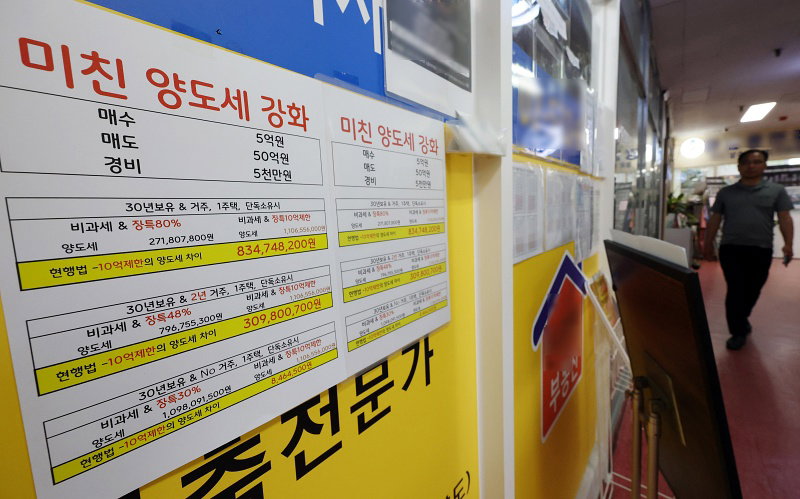
Government revises capital gains tax (Photo: [Provided by Yonhapnews])
▲ Tax burdens intensify for non-resident single-property owners and multi-property owners
Starting next year, taxation on non-resident single-property owners will be significantly strengthened.
For non-resident single-property owners, the basic deduction amount is reduced from 1.2 billion won to 900 million won, and it is analyzed that holding taxes for major complexes in the Gangnam area will increase more than 50-60% from this year.
Tax burdens on multi-property owners also increase sharply.
For owners of two properties at Eunma Apartment in Daechi-dong, Gangnam-gu and Jamsil Kongong 5 Complex in Songpa-gu, the combined holding tax is expected to surge more than 80%, from approximately 44.87 million won this year to around 81 million won next year.
▲ Long-term holding special deduction reduced… capital gains tax bomb of hundreds of millions in 2029
As the ceiling on the long-term holding special deduction for capital gains tax is reduced, the capital gains tax burden on single-property owners who have held ultra-luxury properties for long periods is expected to intensify.
Assuming a purchase of an exclusive 84㎡ unit at Raemian Prestige in Banpo-dong, Seocho-gu for 1.6 billion won 10 years ago and selling it for 5.6 billion won, if sold by next year, the capital gains tax would be approximately 241.85 million won, but if sold in 2029, it would increase to around 945 million won, roughly four times higher.
As both holding tax and capital gains tax burdens intensify simultaneously, the calculation of whether to sell is expected to become complicated, particularly among elderly people and retirees holding ultra-luxury properties.
Copyright © JKN. Unauthorized reproduction or redistribution prohibited.