Looking at the national average and Seoul's average housing price increases, South Korea showed a relatively stable trend compared to major countries. However, the high-end housing market in Seoul recorded world-class growth rates. Analysis has pointed out that rapid price increases in high-end houses centered on the Gangnam area and the Han River belt show significant differences from the overall average, intensifying the polarization of the housing market.
▲ Average housing price growth rates are stable compared to major countries
According to the National Assembly Future Research Institute's report "Asset Inequality and Medium to Long-term Housing Tax Reform Tasks" released on the 2nd, analysis of the Bank for International Settlements' (BIS) nominal housing price index (RPP) showed that Korea's national housing prices rose approximately 1.56 times from 2003 to 2023.
Seoul also saw only a 1.74-fold increase during the same period. The index is calculated by comparing price changes after a specific point in time based on housing prices at that time.
This rate of increase was relatively low compared to major countries and cities. The United States saw approximately 2.8-fold increases, Canada 3.1 times, Norway 3.4 times, Berlin, Germany 3.9 times, and the Oslo metropolitan area in Norway 4.1 times, all recording higher growth rates than Korea.
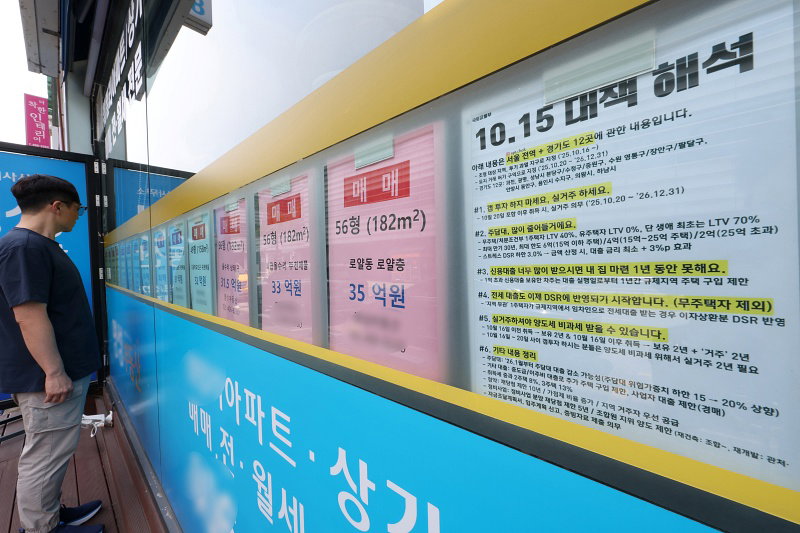
Real Estate (Photo : [Yonhapnews Provided])
▲ Real housing prices also fall below OECD average
In the Organization for Economic Cooperation and Development's (OECD) real housing price index (RHPI), which excludes the effects of inflation, Korea was classified as a stable country.
Real housing prices in Korea in 2024 compared to 2000 rose only 1.2 times, falling below the OECD average of 1.6 times. Among surveyed countries, it recorded the second-lowest growth rate after Finland.
On the other hand, Canada saw a 2.9-fold increase during the same period, showing the highest growth, while Australia, the United States, and the United Kingdom also showed increases of 1.8 to 2.6 times.
▲ Seoul's high-end housing market shows world-class increases
Unlike average housing prices, Seoul's high-end housing market showed a completely different picture.
According to the UK real estate consulting firm Knight Frank's Prime Global Cities Index (PGCI), Seoul's top 5% high-end housing prices in the third quarter of last year rose 25.2% compared to the same period a year earlier. This was the second-highest growth rate among 46 cities worldwide surveyed, after Tokyo, Japan (55.9%).
Considering that the average growth rate for 46 major cities was 2.5%, Seoul's high-end housing increases were at a level 10 times the average. Bengaluru, India in third place showed only 9.2%, showing a large gap compared to Seoul.
In growth rates over the past five years, Seoul recorded 80.9%, ranking fourth globally after Dubai, Tokyo, and Manila, Philippines.
▲ Polarization centered on Gangnam area widens statistical differences
Analysis suggests that the large difference between average statistics and high-end housing statistics occurs because price increases have been concentrated in certain areas such as the three Gangnam districts and the Han River belt.
Knight Frank compiles statistics for only the top 5% high-end housing, while the OECD and BIS calculate indices targeting the entire national or Seoul housing market. This can result in what is called the "trap of averages," where poor performance in non-capital regions and stagnant general housing prices lower average values.
▲ Sample survey limitations also have an impact
The Korean housing price statistics used by the OECD and BIS are based on the Korea Real Estate Board's National Housing Price Trend Survey. The survey is compiled using transaction cases of sample housing and has limitations in that it does not directly reflect actual transaction data, critics have pointed out.
For this reason, during periods of high market volatility like recently, there may be the possibility of insufficient reflection of actual price changes.
▲ Market polarization response becomes a key task
Lee Sun-hwa, senior research fellow at the National Assembly Future Research Institute, analyzed that Seoul's housing market polarization is intensifying, with the price increase gap between high-end and general housing being very large.
She added that although Seoul housing prices surged in 2024 and 2025, the OECD and BIS statistics may not have sufficiently captured these changes due to the nature of the sample survey method.
Copyright © JKN. Unauthorized reproduction or redistribution prohibited.