The U.S. Department of Defense is accelerating the development of advanced defense technology startups by overhauling its defense procurement system.
According to the Wall Street Journal (WSJ) on the 19th (local time), since Defense Secretary Pete Hegseth took office, the military has significantly revised weapons procurement regulations and expanded contract opportunities for startups, drawing large volumes of investment capital into the defense technology ecosystem.
However, analyses suggest that in actual defense budget execution, existing large defense contractors still dominate most contracts, and concerns about stronger congressional budget reviews and overheating investments could slow structural reforms centered on defense startups beyond expectations.
▲ Defense Procurement Reform Initiative...Expanding Startup Participation
Secretary Hegseth has made sweeping changes to weapons procurement procedures that had been maintained for decades since taking office.
He streamlined the complex and time-consuming weapons purchase requirement processes, relaxed some costly cybersecurity regulations, and expanded weapons procurement authority for field commanders.
Additionally, by establishing a startup-exclusive program and simplifying contract procedures, the department lowered the barriers for private technology companies to enter the defense market.
Secretary Hegseth explained that competition, innovation, and rapid deployment should be core values of the defense procurement system, and he continues to reform Pentagon bureaucracy.
▲ Investment Boom Drives Company Valuations Skyward
Investment sentiment toward defense technology startups has rapidly expanded.
Anduril, a representative defense startup, saw its company valuation nearly double from $30.5 billion last year to $61 billion (approximately 90.27 trillion won) in May of this year.
Venture capitalists are investing large sums of capital amid expectations that the defense technology market will fully open.
According to PitchBook, defense and aerospace startup investments in the first half of this year reached $16.8 billion (approximately 24.86 trillion won), exceeding the total investment volume of any single year on record.
Some investors have characterized the current market situation as a bubble. Trey Stevens, co-founder of Anduril, expressed concerns about overheating, noting that company valuations are diverging from reality.
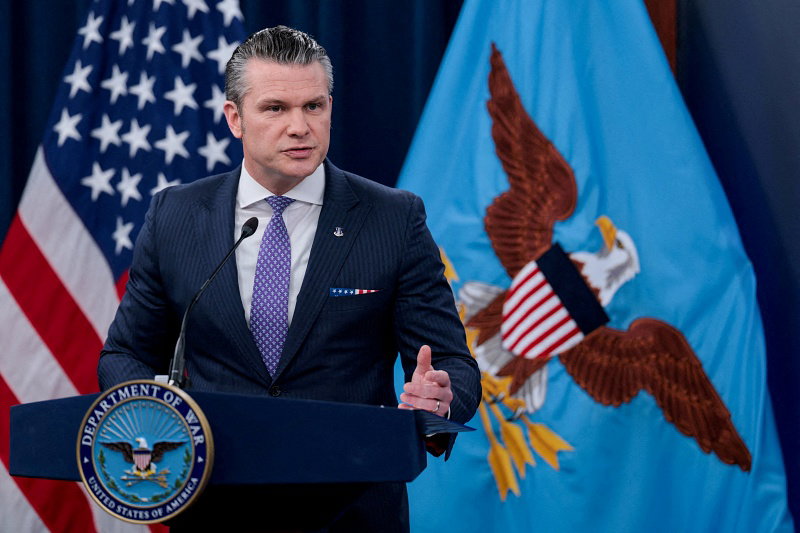
Defense Secretary Pete Hegseth (Photo : [Reuters/Yonhapnews])
▲ Contract Scale Increasing...But Market Share Remains Below 1%
While defense startup contracts are growing rapidly, their share of the overall market remains limited.
According to a report from the National Security Innovation Base under the Ronald Reagan Presidential Foundation, the top 15 defense startups by company valuation saw their defense department contracts triple compared to 2022.
However, these startups account for less than 1% of total defense contracts. This means the structure where existing large defense contractors still secure most of the budget remains intact.
▲ Existing Defense Contractors' Influence Still Overwhelming
According to the Center for Strategic and International Studies (CSIS), approximately 10,000 new defense companies entered the market over the past two years.
Non-traditional defense companies—including venture-backed startups, small and medium-sized enterprises, and private technology companies—secured contracts exceeding $122 billion last year, more than double the level from ten years ago.
However, during the same period, Defense Department spending on existing large defense contractors also increased to $372 billion. Analyses suggest that while startups are growing, a significant portion of actual budget increases still flows to established major defense firms like Lockheed Martin and RTX.
▲ China Containment and Ukraine War Driving Change
Strategic competition with China underlies the expansion of U.S. defense budgets.
Military tensions surrounding Taiwan and global supply chain vulnerabilities revealed after COVID-19 have driven increased defense investments.
In particular, the Ukraine war demonstrated high battlefield efficiency of AI and software-based drones, prompting assessments that the U.S. is accelerating a strategic shift from traditional large-scale weapons systems to unmanned systems.
Investors forecast that future warfare will shift toward AI-based unmanned systems that are cheaper than expensive weapons and capable of mass production.
▲ Actual Combat Still Relies on Aging Weapons
However, assessments indicate that changes in actual military operations are not occurring as quickly as expected.
Even in recent military conflicts with Iran, most major weapons operated by the U.S. were conventional weapons systems developed over 15 years ago.
Among newly deployed weapons were modified attack drones based on Iran's Shahed drone and the unmanned surface vessel from startup Saronic.
This case is analyzed as showing that while cutting-edge startup technology is gaining attention, actual operational deployment remains limited.
▲ Congressional Budget Review as Key Variable
Congressional budget approval has emerged as a key variable for the success of the Defense Department's reforms.
The Defense Department requested a $54.6 billion budget for autonomous weapons development, but Congress is taking a cautious stance on requests to expand the defense budget by a total of $1.5 trillion.
Both Democrats and Republicans are demanding audits of the Defense Department's investment methods, including conflicts of interest with venture capitalists in the startup investment process.
Political burden over defense spending increases following the Iran conflict has also been identified as a factor constraining budget expansion.
▲ Investment Bubble and Technology Verification Challenges Remain
Many defense startups are assessed as not yet having secured the level of technology required by the military.
Even Anduril, a representative company, has reported cases of performance issues and cost increases in some weapons development processes.
Currently, over 400 drone companies operate in the U.S., but industry observers forecast that only 10 to 15 will survive structural reorganization over the coming years.
This means only companies that simultaneously secure technological competitiveness and production capacity can achieve long-term survival.
▲ Contracts Concentrated Among Few Startups
The benefits of market expansion have also been concentrated among certain companies.
According to analysis by market research firm Frontier Optic, 568 defense startups received $4 billion in defense department contracts last year, a significant increase from $1 billion in 2022.
However, compared to the total defense contract volume of $506 billion, this remains modest.
In particular, as Anduril and Saronic account for approximately 25% of all startup contracts, contract concentration has intensified.
Some startups have filed lawsuits and filed protests, claiming the Defense Department awards contracts to only specific companies.
▲ Defense Innovation Has Begun, But the Road is Long
The U.S. Defense Department's procurement reforms are clearly providing new opportunities for defense startups.
In reality, startup contract volumes and venture investments are growing rapidly, and changes in AI and drone-centered future warfare are also accelerating.
In summary, while the U.S. Defense Department has widened its doors to defense startups, actual funding still flows more to large defense contractors. With technological change, investment overheating, and congressional resistance converging simultaneously, the "defense startup innovation" is evaluated as having only just entered the testing phase.
Copyright © JKN. Unauthorized reproduction or redistribution prohibited.