Domestic researchers have finally unveiled the 'first gateway' of brain waste removal, which has remained a long-standing challenge in neuroscience for approximately 250 years, paving the way for a new era in treating neurodegenerative diseases such as dementia.
On July 22, 2026, the research team led by Ko Kyu-young, director of the Vascular Research Center at the Institute for Basic Science (IBS), announced the discovery of 'arachnoid fenestrations,' the key microscopic pores that expel waste from the brain. This groundbreaking discovery clarifies approximately 250 years of scientific challenges regarding the pathway through which cerebrospinal fluid passes through the arachnoid membrane surrounding the brain. The research results were published as a major article in the prestigious science journal 'Cell' on the same day.
The brain is a critical organ that oversees all functions of the human body, and effectively removing waste is crucial for healthy brain function. If brain waste is not properly expelled and accumulates, it can have fatal effects on the onset and progression of various neurodegenerative diseases such as Alzheimer's disease and Parkinson's disease. While it has been well known in the scientific community that cerebrospinal fluid transports brain waste through meningeal lymphatic vessels, how this cerebrospinal fluid precisely passes through the arachnoid membrane surrounding the brain has been an unsolved puzzle for centuries.
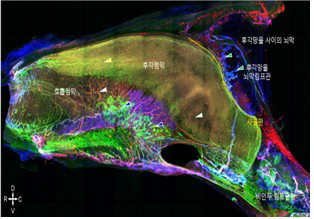
With the discovery of arachnoid fenestrations, the 'first gateway' of the brain waste disposal system, the IBS research team has established a foundation for comprehensive understanding of the entire process through which brain waste is expelled via cerebrospinal fluid. Using specialized mouse models, cutting-edge three-dimensional imaging technology, and high-resolution scanning electron microscopy analysis, the research team elucidated the detailed movement mechanism of cerebrospinal fluid. In particular, they clearly identified the specific pathway through which lymphatic vessels in the olfactory bulb and nasal cavity are precisely connected through a bone called the cribriform plate, and cerebrospinal fluid passes through these arachnoid fenestrations—microscopic pores—to exit the arachnoid membrane and move to lymph nodes around the nose.
[Photo=Yonhapnews]
More importantly, the research suggested the decline in brain waste disposal function with aging and the possibility of its recovery. The research team compared aged mice (85-100 weeks old) with young mice (8-10 weeks old) and found that in aged mice, the function of arachnoid fenestrations and surrounding lymphatic vessels was significantly reduced, with cerebrospinal fluid drainage substantially decreased compared to young mice. However, the research team did not stop there. By non-invasively administering a lymphangiogenic gene (VEGF-C) to the nasal mucosa of aged mice, the team successfully restored the reduced cerebrospinal fluid drainage function to levels comparable to young mice. Director Ko Kyu-young emphasized the historical significance of this discovery, stating, "This research clearly elucidates the 'pathway of cerebrospinal fluid through the arachnoid membrane,' which has been a long-standing challenge since the meningeal lymphatic vessels were first discovered approximately 250 years ago, and will become a new milestone in the history of neuroscience."
The research results have heightened direct applicability to human brain disease research and treatment. Hong Sun-pyo, a research fellow and co-first and corresponding author at the IBS Vascular Research Center, stated, "We confirmed the identical arachnoid fenestration structure in primates, which means we have secured key clues to elucidate the brain cleaning mechanism in humans and to develop non-invasive therapeutic approaches for neurodegenerative diseases such as dementia." Jin Chul-hwa, a researcher at the IBS Vascular Research Center, also contributed as a major participant in this study.
This research has not only revolutionized understanding of the brain waste disposal system but is also expected to serve as an important scientific foundation for more deeply elucidating the causes of neurodegenerative diseases such as Alzheimer's disease and developing new diagnostic and non-invasive therapeutic approaches. The IBS Vascular Research Center plans to expand the scope of future research to human tissues and develop innovative therapeutic strategies applicable to various neurodegenerative diseases. This demonstrates unlimited potential to contribute to improving the health of humanity worldwide and offers great hope to the scientific community and patients.
Copyright © JKN. Unauthorized reproduction or redistribution prohibited.