The KOSPI, which surged 4.40% the previous day and reclaimed the 7,000 level, is drawing attention on July 24 as it faces triple headwinds including international oil prices breaking through $100 due to escalating Middle East tensions and weakness in U.S. stock markets, potentially plunging into another wave of intense volatility.
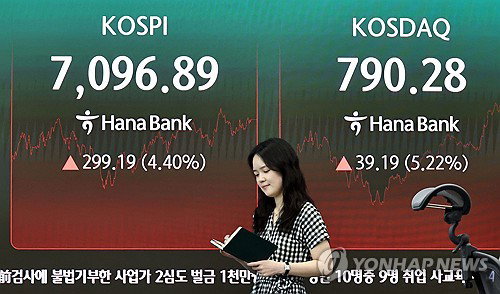
On July 23, the KOSPI closed at 7,096.89, up 299.19 points (4.40%) from the previous trading day. Breaking through the 7,000 level on a closing basis was the first time in five trading days since July 15. The index showed strong momentum, rising nearly 9% with three consecutive days of gains starting July 21. In particular, foreign investors led the index higher with net purchases of 213.58 billion won over four consecutive trading days, while institutions also contributed with 9.75 billion won in net purchases. Individual investors, meanwhile, engaged in net selling of 220.77 billion won over three consecutive trading days.
This upward momentum was bolstered by Google's parent company Alphabet announcing an upward revision of capital expenditure (CAPEX) related to AI investments for 2026 to $195-205 billion. Riding on this, Samsung Electronics and SK Hynix, the semiconductor leaders in the domestic market, saw their stock prices rise 3-4%, lifting the entire market.
However, the market sentiment changed dramatically overnight. A string of negative factors struck all at once: deteriorating Middle East conditions, soaring international oil prices, rising U.S. Treasury yields, and weakness in New York stock markets. U.S. President Donald Trump hinted at reviewing a "major attack" on Iran, while Yemen's Iran-aligned Houthi rebels declared a blockade of the Red Sea targeting Saudi Arabia and claimed responsibility for attacking two Saudi tankers, escalating the Middle East crisis.
Concerns grew that if transit through the Strait of Hormuz, a major crude oil shipping route, were halted and the Bab el-Mandeb Strait were also blockaded, serious disruptions to Middle East crude supply chains would be inevitable. The deteriorating Middle East situation immediately led to soaring international oil prices. September delivery Brent crude futures surged 7.04% to $100.69 per barrel compared to the previous session, marking the highest level since May 22, 2026. U.S. West Texas Intermediate (WTI) September delivery futures also rose 6.17% to $92.19 per barrel, setting a new high since June 4, 2026.
[Photo=Yonhapnews]
Rising oil prices triggered inflation concerns, which led to higher U.S. Treasury yields. The 10-year U.S. Treasury yield rose 4bp (1bp=0.01%p) to 4.70%, marking the highest level in one year and six months since January of last year.
The New York stock market also faced weakness. The Dow Jones Industrial Average fell 0.97%, the Standard & Poor's (S&P) 500 Index declined 1.21%, and the Nasdaq Index dropped 2.15%. In particular, Alphabet, which led the domestic market the previous day, plummeted nearly 7% despite announcing expanded AI investments, amid concerns about free cash flow (FCF) issues, while Tesla stock fell over 14%. This aligns with the analysis by Suh Sang-young, managing director at Mirae Asset Securities, that "the market has evaluated stock prices with the key axis being not how much to invest but when investment funds can be recovered."
Experts forecast that the domestic stock market today (July 24) will likely open lower due to Middle East geopolitical uncertainties stemming from the region, soaring oil prices, and the aftermath of weakness in U.S. stock markets. However, Han Ji-young, a researcher at Kiwoom Securities, suggested that despite the likelihood of a lower opening, semiconductor-led downside rigidity and individual momentum from the second quarter earnings season could limit further market declines.
The direction of the domestic market today will be determined by two major variables: developments in Middle East conditions and companies' second quarter earnings releases. Market attention is focused on whether the steady performance in the semiconductor sector can offset geopolitical risks and oil price shocks.
Copyright © JKN. Unauthorized reproduction or redistribution prohibited.