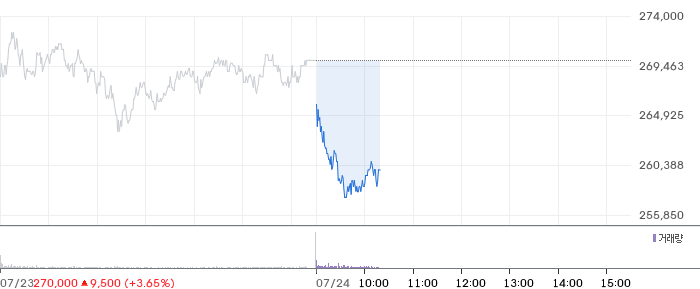
[Chart=Naver Finance]
Samsung Electronics' stock price fell more than 3% during trading on the 24th, dropping below the 250,000 won level.
The unconfirmed disclosure regarding recently circulated market rumors is interpreted as having dampened investor sentiment.
Downward pressure on the stock price appears to be intensifying amid global economic uncertainty.
Samsung Electronics (005930), the largest cap stock on the KOSPI, is showing weakness in domestic markets on the 24th, causing investor concerns. As of 2:30 PM that day, Samsung Electronics was trading at 259,500 won, down 10,500 won (3.89%) from the previous day, falling below the 260,000 won mark. The stock price, which had been showing relatively steady momentum recently, has experienced a sharp decline in a short period, drawing market attention.
The direct background for Samsung Electronics' stock decline on the day is attributed to a recently published "clarification regarding rumors or reports (unconfirmed)." Despite the fact that the disclosure is unconfirmed, making the truth of the content unclear, the mere fact that certain rumors circulated in the market and the uncertain clarification acted as a factor that rapidly cooled investor sentiment. Typically, in the case of large blue-chip stocks, when rumors circulating in the market are publicized in an unconfirmed form, investors tend to strengthen their risk-aversion sentiment and engage in selling. In a situation where accurate details have not been disclosed, "what if" uncertainty has spread throughout the market.
From a supply-demand perspective, concurrent selling by foreign investors and institutional investors is being observed, further fueling the stock price decline. When large stock price fluctuations occur following a specific disclosure, it is clear that big-money investors well-versed in the market tend to move first. In particular, multiple "Executive and Major Shareholder Securities Ownership Reports" filed over the past week were not large-scale sales directly impacting stock prices, but the possibility cannot be ruled out that small-scale transactions by insiders with privileged information played a role in heightening market sensitivity. This is because it could be interpreted as a signal that "even insiders are watching and waiting."
Global economic conditions and semiconductor industry outlook are also factors adding to the downward pressure on Samsung Electronics. While growth expectations remain for high-bandwidth memory (HBM) and artificial intelligence (AI) semiconductor sectors, some analyses suggest that the recovery in traditional demand sources for memory semiconductors—the smartphone and PC markets—is slower than expected. Intensified competition in the foundry sector and increased costs for advanced process development can also be factors that raise doubts about long-term profitability. As the overall investment sentiment in the large-cap technology stock sector to which Samsung Electronics belongs is undergoing adjustment, individual negative disclosures are analyzed as having greater ripple effects.
Some observers also hold a conservative view that this decline may be a correction from short-term overheating. Samsung Electronics has recorded considerable gains riding the wave of AI chip fever. Within this upward trend, some investors were feeling valuation burden, and the "rumor clarification" disclosure may have provided an opportunity for profit-taking. In the short term, it is a common pattern in the large-cap market to see adjustments following rapid stock price surges without uncertainty being resolved.
An industry official stated, "Large-cap stocks like Samsung Electronics have no choice but to react sensitively to small uncertainties," and advised, "Particularly, unconfirmed disclosures can cause market confusion and draw selling pressure regardless of whether the content is true or false. Investors need to take a cautious approach while waiting for specific details regarding the rumor and the company's final clarification." Currently, the stock price appears to be testing support levels in the mid-to-late 250,000 won range, and in the short term, whether support holds at the 250,000 won level will be important. If the 250,000 won level breaks down, additional downward pressure could intensify, requiring investors' special caution. In the long term, the stock price direction is expected to be determined by the recovery of global IT demand in the second half and the results of the competition for dominance in the AI semiconductor market.
This article is not investment advice, and the responsibility for investment decisions lies with the investor themselves.
[Investment Caution] The data and analysis content provided in this article are reference information only based on market conditions and do not guarantee returns on specific stocks or recommend buying or selling. All final decisions and responsibilities for investments lie with the investor themselves.
Copyright © JKN. Unauthorized reproduction or redistribution prohibited.