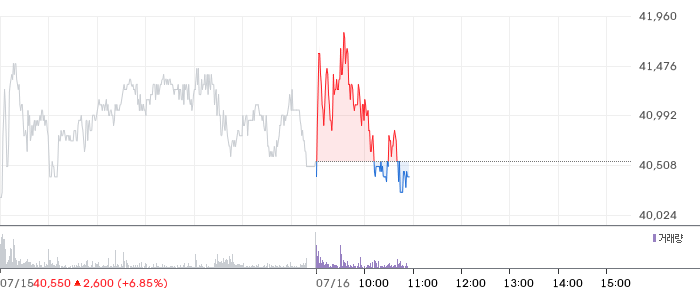
Kakao Pay (377300) stock price showed a slight decline during today's trading session, trading at 40,450 won. With no major negative news, institutional and foreign investors are taking a wait-and-see approach, while pressure for short-term profit-taking is intensifying. This is interpreted as an impact of unresolved valuation concerns across the fintech sector.
In the KOSPI market, Kakao Pay (377300) stock price is continuing its weak trend, recording 40,450 won as of July 16, 2026, down 100 won (-0.25%) from the previous day. The slight decline in stock price this morning without any major negative news or announcements is analyzed as reflecting fatigue from the recent sharp rise and a cautious approach by investors. Trading volume during the session has been relatively sparse, with weak inflows of strong buying interest while small-scale profit-taking sales are pushing the stock price down.
From a supply and demand perspective, foreign investors and institutional investors are maintaining a wait-and-see stance or showing a slight selling edge. Over the past several trading days, Kakao Pay stock price has fluctuated within a certain range rather than showing a specific direction, and today's decline is characterized as short-term price adjustment. In particular, retail investors are showing a slight net buying trend, but this is insufficient to change the overall market direction. This is also largely influenced by the contraction of investment sentiment in growth stocks amid continued macroeconomic uncertainty and a high interest rate environment.
While Kakao Pay has secured a distinctive position in the domestic fintech market, strengthened regulatory measures on platform companies and intensified competition continue to serve as burden factors. As of 2026, the company is expanding its business scope beyond simple payment and remittance services to include financial product brokerage such as investment and insurance; however, the competitive landscape is becoming more intense due to accelerated digital transformation by existing financial institutions and new service launches by big tech companies. The possibility of delayed profitability in new business areas or results lower than expected cannot be ruled out as a potentially negative impact on the stock price.